
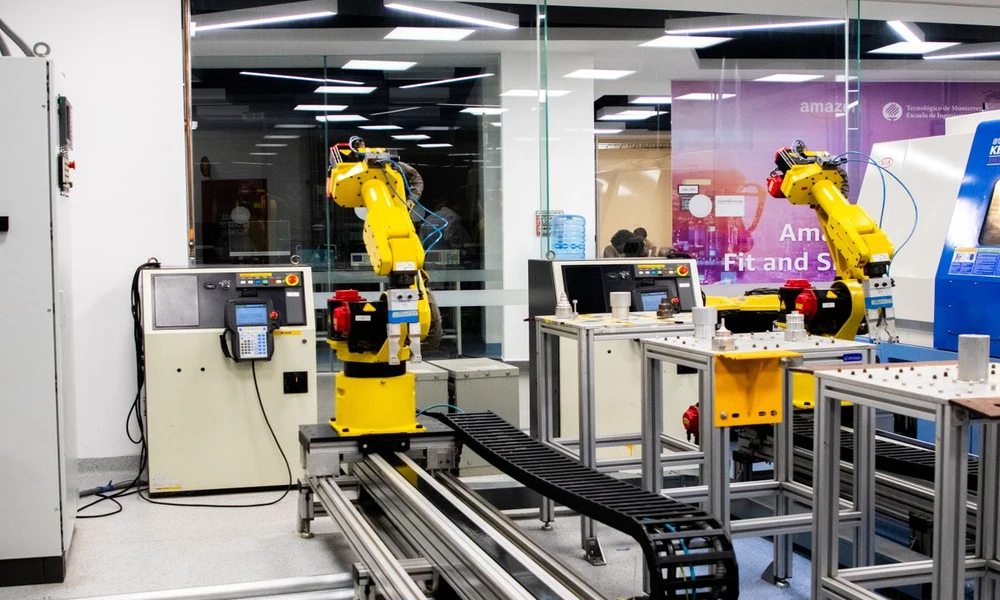
Walk through most modern manufacturing facilities today and you’ll notice something has changed, even if it’s not immediately obvious. Fewer people are standing at inspection stations squinting at parts under a lamp. Fewer defective products are slipping through to the customer. And production lines that used to slow down every time something went slightly wrong now catch problems in milliseconds, often before a human eye could have spotted them at all. That shift is being driven by machine vision – cameras, sensors, and AI working together to see, judge, and act on what’s happening on the line, faster and more consistently than manual inspection ever could.
What Machine Vision Actually Does
At its simplest, an industrial vision system is a camera paired with software trained to recognise specific things: a scratch on a casing, a missing component, a label printed slightly off-centre, a weld that doesn’t quite meet spec. What makes modern systems genuinely useful, rather than just automated cameras, is the AI layer underneath. Instead of relying on rigid rule-based checks that break the moment lighting or product variation shifts, machine learning models can be trained on thousands of example images and learn to spot anomalies that weren’t explicitly programmed in. That flexibility is the real leap forward from the machine vision of a decade ago.
Why Manufacturers Are Investing Now
A few forces are converging at once. Labour shortages in skilled inspection roles have made consistent manual quality control harder to guarantee. Customers and regulators are less tolerant of defects reaching the market, particularly in sectors like automotive, pharmaceuticals, and food packaging, where a missed fault has real safety implications. And the cost of vision hardware – cameras, lighting rigs, edge-computing units – has dropped enough that the return on investment for mid-sized manufacturers, not just the automotive giants, now makes sense.
Specialists like Industrial Vision Systems work directly with manufacturers to design and integrate bespoke inspection setups, which matters because off-the-shelf vision products rarely fit a production line without meaningful customisation – lighting angles, camera placement, and defect-detection thresholds all need tuning to the specific product and process.
Beyond Defect Detection
Quality inspection is the most visible use case, but it’s far from the only one. Vision systems are now handling robotic guidance – helping robotic arms pick, orient, and place components with millimetre precision. They’re tracking inventory in real time by reading labels and barcodes as products move through a facility. And increasingly, they’re feeding data back into predictive maintenance systems, spotting the visual signs of equipment wear – a fraying belt, a leaking seal – before a breakdown actually happens.
The Human Side of the Shift
It’s worth saying plainly: this technology changes jobs rather than simply eliminating them. Inspection roles are shifting toward system oversight, exception handling, and the ongoing work of retraining models as products change. For manufacturers navigating that transition, the UK government’s Made Smarter programme offers useful, vendor-neutral guidance on adopting industrial digital technologies, including practical case studies from other manufacturers who’ve been through the same process.
Looking Ahead
Machine vision won’t replace human judgement on a factory floor entirely, and it shouldn’t try to. What it does well is remove the tedious, repetitive, error-prone parts of visual inspection and free people up for the judgement calls that genuinely need a human. As the underlying AI models keep improving and hardware costs keep falling, expect to see this technology move further down the size scale, from automotive giants and pharmaceutical plants into smaller manufacturers who, until recently, simply couldn’t justify the cost. The factory floor of the next decade will look a lot like today’s – just with a lot more quietly watching cameras keeping everything on track.