
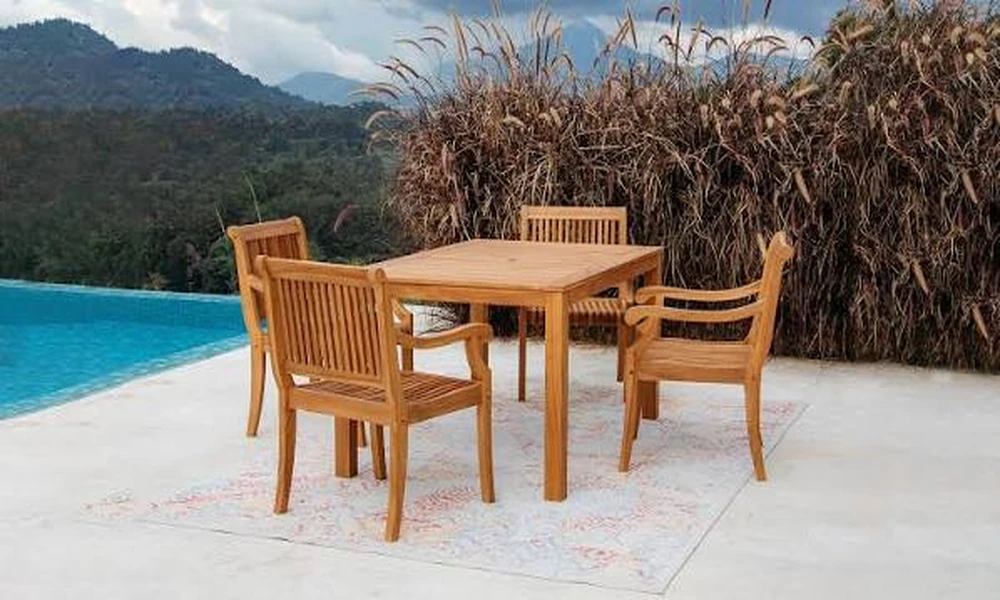
Most patio sets die in year three, and almost none of them die from sitting in the rain. They die from heat, humidity, and a buyer who picked a set based on how it looked on a showroom floor in April. If you live anywhere between the Piedmont and the coast, your furniture faces a summer that punishes cheap materials in slow motion.
Here’s the deal: a South Carolina summer isn’t one weather problem, it’s three stacked on top of each other. Weeks of high humidity, strong UV, and afternoon storms that arrive fast and leave standing water behind. Each one attacks a different part of the set. Get the material story right and your furniture can last a decade. Get it wrong and you’re shopping again before the warranty runs out.
This guide walks you through what actually holds up, where people overspend, and how to test a piece before it ever reaches your porch. If you want to skip the research phase and just see what holds up in person, browsing patio furniture near Greenville, SC gives you a real look at how different frames and fabrics handle the local climate instead of judging from a thumbnail.
What does a Carolina summer actually do to patio furniture?
The Upstate gets hot and sticky, and the coast gets hotter and stickier. According to climate data from the National Weather Service, the Southeast routinely logs stretches of high heat and humidity through the summer months, which means your furniture sits in moisture most of the day, not just during a storm.
That moisture is the quiet enemy. It creeps into wood grain, into welds, into the stitching on your cushions. UV is the loud enemy. It bleaches fabric, dries out wicker, and makes plastic go chalky and brittle. So you’re solving for two things at once: water resistance and sun resistance. A set that wins on one and loses on the other will look tired by the second summer.
I’d rank humidity as the bigger threat here. You can throw a cover over a set during the worst sun and forget about it. You can’t escape six weeks of damp air working its way into a joint.
Frame materials, ranked by my own bias
Every buyer faces the same fork in the road: metal, wood, or resin wicker. Here’s how I’d call each one for a Greenville-area porch.
Powder-coated aluminum
This is my pick for most people. It won’t rust the way steel can, it’s light enough to drag across a deck alone, and modern powder coats hold color far better than painted metal from twenty years ago. The tradeoff is weight. A good aluminum chair feels solid, but wind isn’t as afraid of it as you’d like, so lift the cushions before a storm.
Teak and other hardwoods
Wood is the warmest option and arguably the most beautiful after a few seasons of patina. It also needs the most attention. Teak handles humidity better than softer woods, but if left bare it will gray out, and that’s fine if you like the look and annoying if you don’t. Plan on an annual oiling if you want the honey color to stay.
Resin wicker
Cheap resin wicker cracks and fades. Good resin wicker, the kind wrapped tight over an aluminum frame, can fool almost anyone at ten feet and shrugs off moisture. The tell is the wrap. Run your fingers along the weave of a sample. Loose, springy strands mean it’ll unravel. Tight and consistent means it was built to last. Skip this category entirely if all you can find is the budget version sold in flat boxes.
The fabric and cushion decisions that actually matter
Frames get all the attention, but the cushions are where most people feel buyer’s remorse first. A cheap foam cushion in a humid climate turns into a sponge, and a sponge grows things you don’t want on your patio.
Look for quick-dry foam, which has open cells that let water pass through instead of trapping it. Pair that with a solution-dyed acrylic fabric if you can find it in your budget. That’s the stuff that keeps color rather than bleaching after a season of direct sun.
- Quick-dry foam core, not closed cell block foam
- Solution-dyed acrylic or a proven outdoor-grade polyester
- Removable, zippered covers so you can wash them
- Zippers that are hidden but accessible, not stitched shut
And here’s a small thing that saves a lot of grief: buy cushions that are slightly firmer than the ones you liked in the showroom. They soften with use and heat, and a cushion that starts too soft will bottom out by August.
A five minute test before you pay
You can learn more about a patio set in five minutes in person than in an hour of reading specs online. I’d use this routine every single time, and I’d walk away from anything that fails step three.
- Lift one chair. If it’s shockingly light for its size, the frame is probably thin. If it’s too heavy to move alone, you’ll hate rearranging your patio.
- Stick your nose into the cushion. Any chemical or musty smell tells you the foam or fabric held moisture before it ever left the warehouse.
- Wiggle the joints. Grab an armrest and apply real pressure. Squeaks and give mean weak welds or loose fasteners.
- Flip it over. Look at the underside. Neat welds and rust-resistant hardware on the bottom are a sign the maker cared about the parts you’ll never show off.
- Ask what the set is rated for. A good salesperson can tell you the frame material, the fabric grade, and roughly how much sun the finish tolerates. Vague answers are an answer.
The Energy Department’s guidance on energy efficient home products makes a point that applies here too: durable materials tend to cost less over their life than cheap ones replaced often. That math holds up on patio furniture as well as it does on windows.
Where people overspend and where they shouldn’t
You can spend a small fortune on outdoor furniture and get very little extra for it. The biggest waste I see is paying a premium for a designer name on a frame that’s the same aluminum as the set down the street. That’s not value, that’s a logo.
Where it’s worth paying more: the fabric, the foam, and the finish. Those three things determine whether your set looks good in year five. Everything else is style. And style matters, just not enough to overrule a weak frame.
My one contrarian take: don’t buy a huge matching set at once. Start with a table and four chairs, live with it for a season, then add the lounge pieces once you know how you actually use the space. Most people overbuy seating and underbuy shade.
Keeping a good set good in a humid climate
Routine care is boring and it’s also the whole game. Wipe down frames a few times a season, especially after a run of storms. Store cushions indoors or in a deck box when you’re not using them, because no outdoor fabric likes sitting in damp air for weeks on end. Cover the furniture during the off months if you can, and if you can’t, at least clear leaves and debris so water drains instead of pooling.
The EPA’s page on indoor air quality is a good reminder that what lives in damp materials isn’t just an ugly stain. Keeping your outdoor textiles dry and clean protects your furniture and your family’s comfort at the same time.
Pick the frame, pick the fabric, then enjoy the porch
A South Carolina summer will tell you the truth about your patio set within a couple of seasons, whether you want to hear it or not. The good news is that surviving it isn’t about spending the most money. It’s about getting the frame and fabric right and then doing the small maintenance nobody wants to talk about.
So before you buy, think like the climate, not the catalog. Test the joints, smell the cushions, ask real questions. Your porch is too good a spot to waste on furniture that quits early. What’s the oldest piece of outdoor furniture you own, and what did it get right that the rest didn’t?